
Rules for Carrying Rice, Lentils, Ghee & Honey on International Flights 2026: Cabin vs Check-in Baggage Guide
1. Ghee & Honey: Under International Civil Aviation Organization (ICAO) and IATA LAGs (Liquids, Aerosols, and Gels) regulations, ghee, honey, and mustard oil are classified as liquid/semi-liquid substances. Consequently, they are strictly prohibited in cabin hand luggage if container capacity exceeds 100ml. Security X-ray screeners will instantly confiscate non-compliant items. They must be packaged in leak-proof food-grade plastic containers and placed inside checked baggage.
2. Rice & Lentils: As dry solid foodstuffs, packaged rice, lentils, and powdered spices are completely legal in checked baggage for personal consumption (typically 5–10 kg in clean, sealed plastic packets).
When traveling from Bangladesh to destination countries in the Middle East (Saudi Arabia, UAE, Qatar, Oman, Kuwait, Bahrain), Europe, or North America for employment or higher education, almost every traveler wishes to carry authentic home-cooked delicacies, pure ghee, organic honey, aromatic rice, and spices. However, due to misconceptions about international aviation security rules and agricultural plant quarantine restrictions, hundreds of passengers see their precious food items confiscated at Hazrat Shahjalal International Airport (Dhaka) or transit security hubs every year. This exhaustive 2026 guide details the exact aviation protocols and scientific packing methods to guarantee safe transit.
1. Cabin Baggage vs Check-in Luggage: The 100ml LAGs Aviation Restriction for Ghee & Honey
Under global aviation safety mandates, carry-on cabin baggage (the bag carried into the passenger cabin) is strictly restricted to liquids, creams, gels, and pastes in containers of 100ml (or 100 grams) or less, placed inside a single transparent resealable plastic bag. Many passengers assume solid or solidified ghee counts as a solid; however, aviation 3D CT scanners and dual-energy X-ray systems identify oil density immediately, flagging it as a regulated liquid gel.
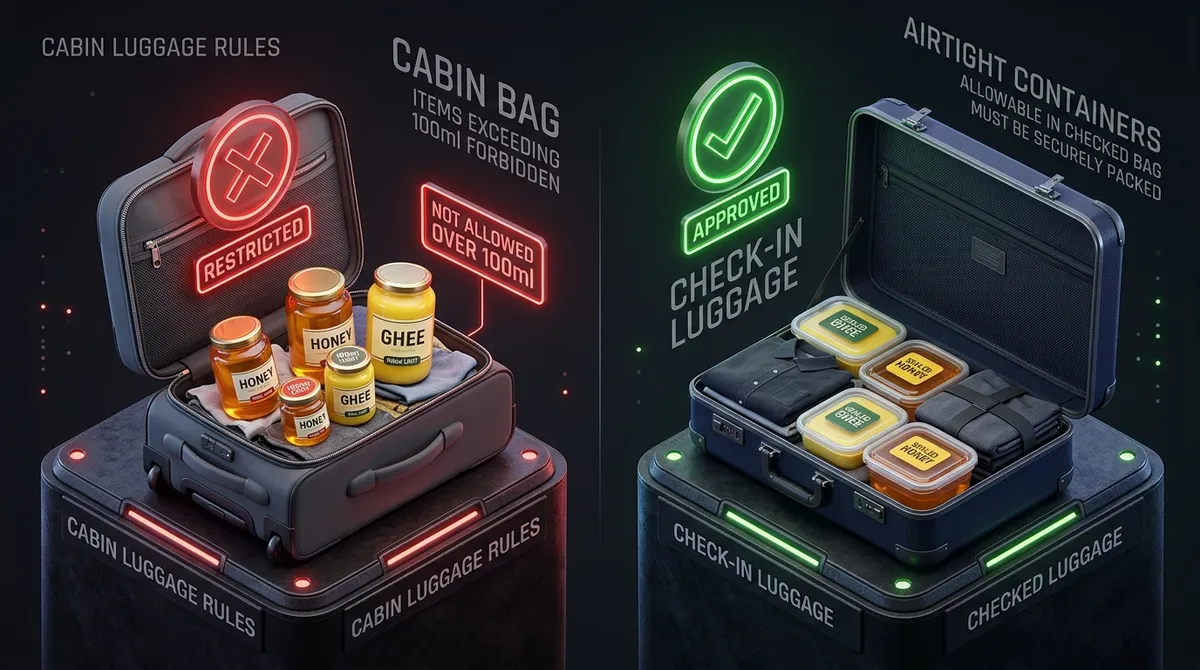
Aircraft cargo holds experience significant atmospheric pressure and temperature shifts. During baggage loading and conveyor transit, suitcases are subjected to severe impact. Glass bottles easily shatter, ruining all packed clothing. Furthermore, if leaking oil damages other passengers' luggage, the airline may levy substantial decontamination penalties. Always use shatter-proof, food-grade plastic containers.
2. Four-Step Scientific Leak-Proof Packing Method for Ghee, Honey & Oils
No matter how rough luggage handling is during transit, following this four-step scientific packing protocol guarantees zero leakage:
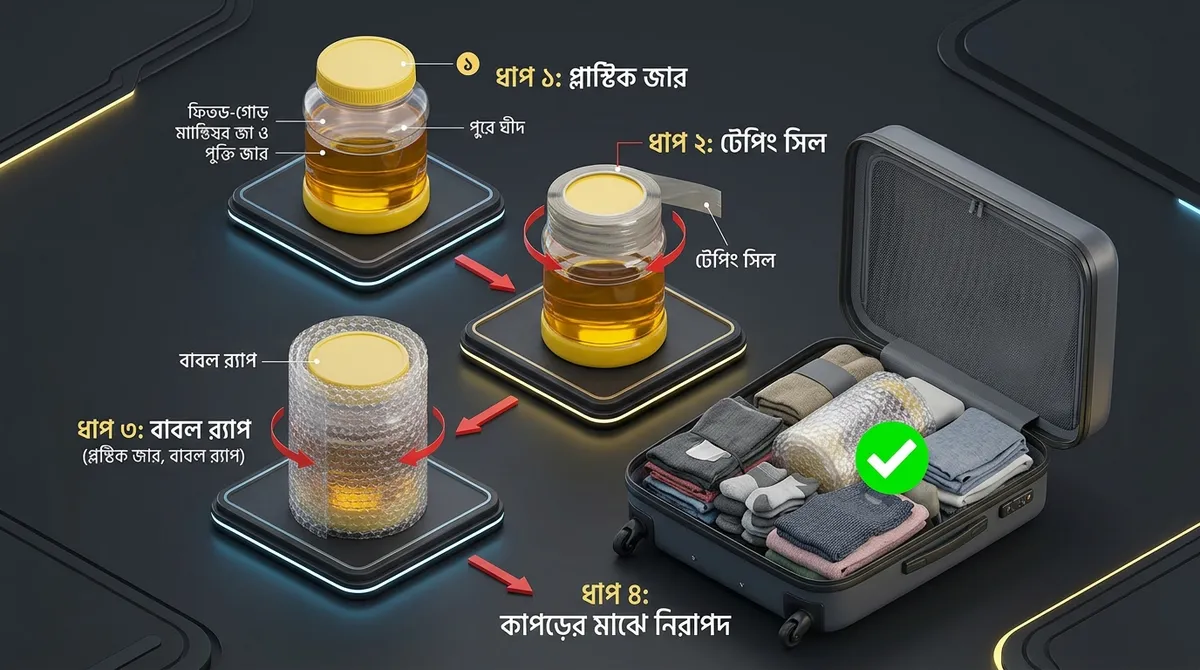
Before screwing on the container lid, place two layers of clean polythene or cling film over the jar mouth, then screw the cap down tightly over it.
Wrap heavy-duty electrical or waterproof duct tape around the entire rim and seam of the lid 3 to 4 times to create an airtight lock.
Enclose the taped container in an airtight Ziploc bag, wrap it in bubble wrap, and place it into a second heavy-duty Ziploc pouch.
Position the packed container in the dead center of your suitcase, surrounded by jeans, winter jackets, or heavy towels to serve as shock absorbers.
3. Allowance Matrix & Maximum Weight Limits for Traditional Food Items 2026
The official aviation customs allowances and recommended packaging specifications for food items are summarized below:
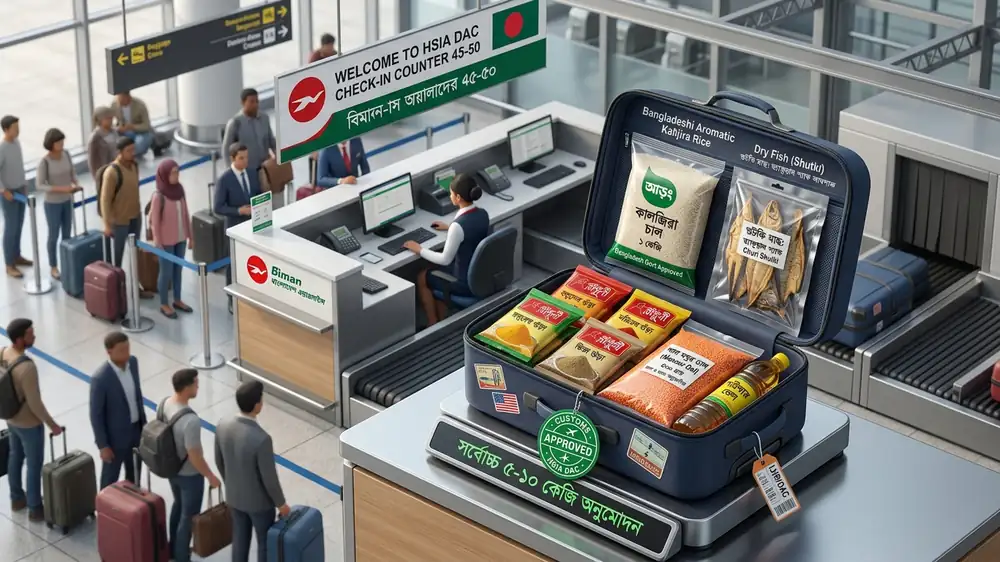
| Food Item | Permitted Baggage | Personal Allowance | Mandatory Packaging Rules |
|---|---|---|---|
| Pure Cow Ghee | ✅ Checked Baggage Only | 2 to 3 kg | Food-grade plastic jar + double tape seal |
| Organic Natural Honey | ✅ Checked Baggage Only | 2 to 5 kg | Plastic container + double Ziploc wrap |
| Aromatic / Basmati Rice | ✅ Checked Baggage (Prohibited in Cabin) | 5 to 10 kg | Factory-sealed packet or airtight thick pouch |
| Lentils & Pulses (Daal) | ✅ Checked Baggage | 3 to 5 kg | Dry, insect-free, sealed plastic bags |
| Powdered Spices (Turmeric, Chili) | ✅ Checked Baggage | 2 to 3 kg | Original commercial packaging (loose spices leak odor) |
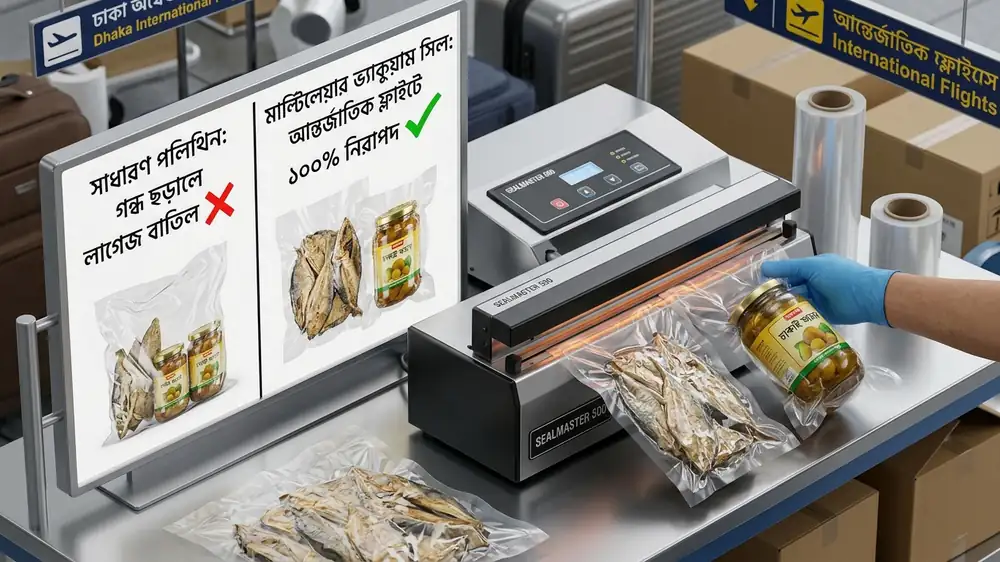
| Dried Fish (Shutki) | ✅ Checked Baggage (Conditional) | 1 to 2 kg | 100% vacuum-sealed (zero odor leakage) |
4. Importance of Vacuum Packing for Dried Fish & Odorous Items
Dried fish (Shutki) and spicy pickles emit strong volatile aromas. If odor escapes into the aircraft cargo compartment or baggage sorting zone, automated sensors alert security, resulting in bags being held for manual inspection. The only compliant method to transport dried fish is through commercial vacuum sealing that eliminates all residual air and odor.
5. Prohibited Agricultural & Food Items at Gulf and European Airports
Food safety authorities in Saudi Arabia (SFDA), the UAE, Qatar, Oman, and the European Food Safety Authority (EFSA) have instituted zero-tolerance prohibitions on the following items:
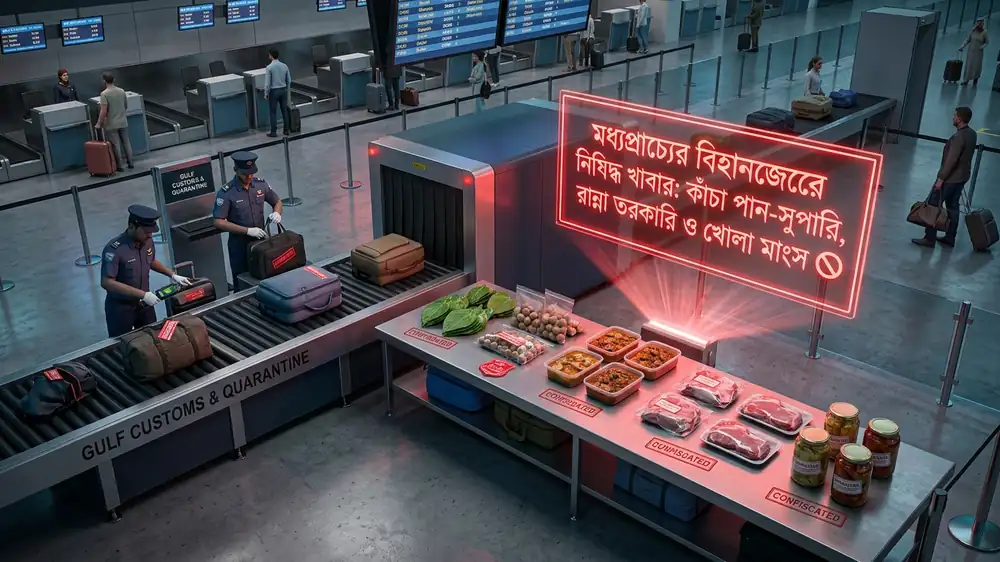
- Betel Leaves (Paan), Betel Nuts (Supari) & Zarda: In Dubai, Oman, and Saudi Arabia, fresh paan is treated under narcotics control laws, resulting in heavy fines and immediate deportation.
- Raw Meat & Perishable Cooked Curries: Transporting raw meats or perishable liquids in cargo is strictly illegal under disease control protocols.
- Fresh Seeded Fruits (Mangoes, Guavas, Jackfruit): Under international plant quarantine rules, whole fresh fruits are destroyed upon arrival to prevent foreign pest infestation.
- Poppy Seeds (Posto Dana): Poppy seeds are categorized as narcotics in all Gulf countries. Carrying poppy seeds can lead to arrest and imprisonment.
📋 The 5-Point Golden Pre-Flight Food Packaging Checklist
- ✅ Ghee, honey, and oils are placed 100% in checked luggage (never in cabin bags).
- ✅ No glass jars or bottles are used—only robust, food-grade plastic containers.
- ✅ Jars feature internal polythene seals and heavy-duty outer duct taping.
- ✅ Dried fish and spices are hermetically vacuum-sealed with zero odor leakage.
- ✅ Banned items like betel leaf, poppy seeds, and fresh perishable fruits are completely excluded.
❓ Frequently Asked Questions (FAQ)
1. Can I carry a small 50g or 100g honey bottle in my carry-on bag? ▼
Yes. Under international LAGs rules, containers holding 100ml (or 100g) or less are permitted in hand luggage when packed in a clear, resealable 1-liter plastic bag. Any container exceeding 100ml will be confiscated immediately.
2. Will glass jars of ghee be detected by airport scanners? ▼
Yes. Modern 3D computed tomography (CT) scanners identify glass and liquid densities clearly. Due to the high risk of breakage in cargo holds, airlines mandate plastic containers.
3. What is the maximum allowed weight for rice and lentils? ▼
Within your airline's total checked baggage allowance, 5 to 10 kg of packaged rice and lentils for personal use is standard. Carrying larger quantities may trigger commercial customs scrutiny.
4. Is bringing pure ghee allowed into Saudi Arabia? ▼
Yes. The Saudi Food and Drug Authority (SFDA) permits pure ghee for personal use when sealed securely in plastic containers inside checked luggage.
5. How should homemade mango or olive pickles be packed? ▼
Pack pickles in sturdy plastic jars with taped lids, seal them in double Ziploc bags, and place them exclusively in checked luggage.
6. Will dried fish cause customs issues at Dubai Airport? ▼
If dried fish is professionally vacuum-sealed with zero emitting odor, it passes Dubai Customs without objection.
7. Can mustard oil be transported on flights? ▼
Yes, 1 to 2 liters of mustard oil in leak-proof, taped plastic bottles inside checked luggage is permitted for personal use.
8. Can spice powders be carried in cabin hand luggage? ▼
Powders over 350g in cabin luggage are subject to secondary screening and potential confiscation on international routes. Keep all spices in checked bags.
9. Is date molasses (Patali Gur / Jhol Gur) allowed on flights? ▼
Solid molasses blocks (Patali Gur) are allowed in both cabin and checked baggage. Liquid molasses (Jhol Gur) must be in checked bags with leak-proof seals.
10. Does an airline compensate if food leaks and damages clothes? ▼
No. Airlines do not compensate for damage caused by improper packing of liquids, and passengers can be held liable if leaks ruin other travelers' baggage.